
Metaverse Market Data Across Virtual Platforms
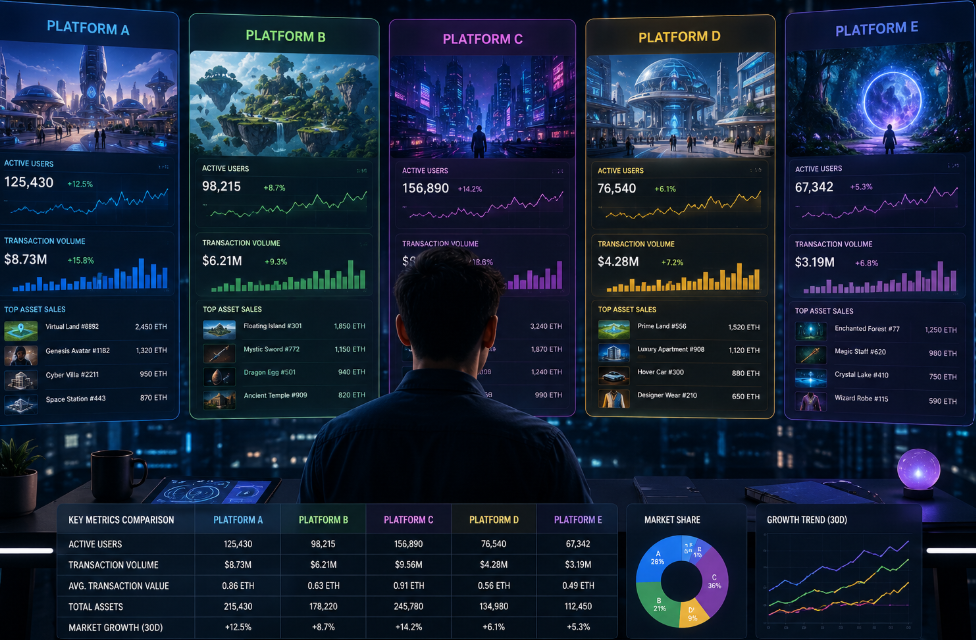
The digital economy continues evolving rapidly, and metaverse market data now plays a major role in understanding virtual worlds, online assets, and digital user behavior. As multiple metaverse ecosystems expand across gaming, social interaction, commerce, and virtual real estate, businesses and investors increasingly rely on data analysis to compare performance across platforms.
However, comparing virtual economies is not always straightforward. Different metaverse projects operate with unique technologies, currencies, governance systems, and user engagement models. Some focus heavily on gaming experiences, while others prioritize virtual property, creator economies, or social interaction.
Because of these differences, analyzing growth patterns and economic performance requires more than simply reviewing user numbers or token prices. Metrics such as active wallets, transaction volume, NFT activity, virtual land sales, engagement duration, and platform interoperability all influence how virtual ecosystems perform.
In addition, market volatility creates further complexity. Crypto fluctuations, changing regulations, technological upgrades, and shifting consumer behavior can quickly alter platform valuations and activity levels.
Understanding how to evaluate metaverse market data helps investors, developers, brands, and researchers identify meaningful trends while avoiding misleading comparisons between virtual platforms with very different operational structures.
Why Metaverse Data Has Become Important
Virtual economies now generate billions of dollars in digital transactions involving NFTs, gaming assets, virtual land, advertising, digital fashion, and blockchain-based financial activity. As this digital infrastructure grows, organizations increasingly need accurate analytics to evaluate performance and market potential.
Businesses entering virtual environments often compare user activity, demographic trends, and transaction patterns before launching products or partnerships. Reliable data helps brands identify which platforms align best with their target audiences.
Investors also rely heavily on analytics to assess project sustainability. Metrics such as user retention, marketplace activity, developer engagement, and token utility often provide stronger insight than hype-driven marketing alone.
Developers benefit from market intelligence too. Understanding competitor growth patterns and user behavior may help guide feature development, monetization strategies, and community management decisions.
Governments and researchers increasingly monitor virtual economies as well. Some regulators now evaluate how digital assets and decentralized ecosystems affect taxation, consumer protection, and online financial activity.
Because the industry evolves quickly, metaverse market data has become essential for separating sustainable ecosystem growth from short-term speculation or marketing trends.
The Challenge of Comparing Different Platforms
One major difficulty in analyzing metaverse ecosystems involves the lack of standardized measurement systems. Each platform often defines user activity and engagement differently.
For example, one virtual world may measure daily active users based on wallet connections, while another counts avatar logins or gameplay sessions instead. These inconsistent metrics make direct comparisons difficult.
Revenue models vary significantly too. Some ecosystems generate income through NFT sales and land ownership, while others rely more heavily on subscriptions, advertising, or gaming transactions.
Blockchain integration also differs between platforms. Certain metaverse projects operate fully on decentralized infrastructure, while others combine centralized systems with blockchain features selectively.
Token economics create additional complexity. Native currencies fluctuate based on crypto markets, platform demand, staking systems, and speculative trading activity.
Cross-platform interoperability remains limited as well. Digital assets purchased in one ecosystem often cannot move freely between other virtual worlds.
Because of these inconsistencies, analyzing metaverse market data requires careful interpretation rather than relying solely on headline numbers or isolated performance indicators.
User Activity as a Core Market Indicator
User engagement remains one of the most important metrics when comparing virtual platforms. Active communities often indicate stronger long-term sustainability than short-term speculative investment alone.
Daily active users and monthly active users commonly measure platform participation levels. However, analysts must evaluate how each project defines activity before comparing results directly.
Engagement duration also matters significantly. Some platforms attract large numbers of brief visitors, while others maintain smaller but highly engaged communities spending substantial time inside virtual environments.
Social interaction metrics provide additional insight too. Events, creator participation, digital commerce activity, and multiplayer collaboration often indicate stronger ecosystem health.
Retention rates may reveal more valuable information than user spikes caused by temporary marketing campaigns or token incentives. Platforms capable of maintaining consistent engagement often demonstrate greater long-term viability.
Virtual event participation has become another important signal. Concerts, conferences, gaming tournaments, and digital brand activations often generate substantial traffic and media attention.
When evaluating metaverse market data, analysts frequently prioritize active community behavior because sustainable ecosystems depend heavily on long-term user participation rather than temporary speculation alone.
Virtual Real Estate and NFT Transactions
Virtual property markets represent one of the most visible sectors within metaverse economies. Digital land sales, NFT ownership, and virtual asset trading often generate substantial transaction volumes across platforms.
Some metaverse projects emphasize scarce digital land ownership models where users purchase plots for development, advertising, gaming experiences, or social interaction. Land scarcity frequently influences pricing behavior and speculative activity.
NFT marketplaces also contribute heavily to ecosystem economics. Users buy and sell avatars, digital wearables, artwork, accessories, and in-game items using blockchain-based ownership systems.
Transaction volume helps analysts evaluate marketplace liquidity and economic activity. However, high trading volume alone does not always indicate healthy ecosystem growth because speculative trading sometimes inflates short-term metrics artificially.
Unique wallet activity often provides stronger insight into genuine user participation. Large numbers of active buyers and sellers generally suggest broader ecosystem adoption.
Asset utility matters too. NFTs with functional use inside virtual environments often maintain stronger long-term value than purely speculative collectibles.
As virtual economies expand, metaverse market data related to NFTs and digital property continues playing a central role in evaluating ecosystem maturity and commercial viability.
How Blockchain Infrastructure Influences Analytics
Blockchain technology significantly shapes how virtual ecosystems collect, verify, and analyze data. Platforms built on decentralized infrastructure often provide more transparent transaction visibility compared to fully centralized systems.
Public blockchain records allow analysts to monitor wallet activity, transaction history, NFT ownership, and token transfers directly. This transparency improves market visibility while supporting independent analytics research.
However, blockchain fragmentation creates challenges too. Different metaverse projects operate on Ethereum, Solana, Polygon, Avalanche, or proprietary chains with varying transaction speeds, fees, and interoperability standards.
Gas fees may affect user behavior significantly as well. High transaction costs sometimes reduce marketplace activity or discourage smaller users from participating regularly.
Layer-2 scaling solutions increasingly influence analytics too. Faster and cheaper blockchain systems may improve user growth by making virtual economies more accessible.
Cross-chain compatibility remains another major factor. Ecosystems capable of integrating assets and users across multiple networks may attract broader adoption over time.
Blockchain architecture therefore plays a major role in how metaverse market data gets interpreted across different virtual environments and digital economies.
Token Economies and Market Volatility
Most blockchain-based metaverse platforms rely on native digital currencies to support transactions, governance, rewards, and marketplace activity. These token systems create unique economic structures that influence overall ecosystem performance.
Token price fluctuations strongly affect user behavior and investor sentiment. Rising token values often increase platform visibility and speculative activity, while sharp declines may reduce participation and marketplace confidence.
Liquidity levels matter significantly too. Thinly traded tokens may experience extreme volatility that distorts economic indicators temporarily.
Staking mechanisms influence market dynamics further. Some platforms reward users for holding tokens or participating in governance systems, which may reduce circulating supply and affect pricing behavior.
Inflation models create additional complexity. Projects issuing excessive token rewards sometimes face long-term sustainability concerns if demand growth fails to match supply expansion.
External crypto market conditions also affect virtual economies heavily. Bitcoin and Ethereum volatility frequently influence broader investor sentiment across metaverse sectors.
Because token systems vary widely between ecosystems, comparing metaverse market data requires careful analysis of how digital currencies support or weaken long-term platform sustainability.
Brand Partnerships and Commercial Activity
Major brands increasingly enter virtual worlds through digital stores, NFT campaigns, gaming collaborations, and immersive marketing experiences. Commercial activity has therefore become an important metric for evaluating ecosystem maturity.
Luxury fashion companies, sports organizations, entertainment brands, and technology firms now experiment with virtual experiences across different metaverse environments.
Brand participation often increases media visibility and user engagement simultaneously. High-profile partnerships may attract new audiences unfamiliar with blockchain or virtual economies previously.
Advertising revenue potential also influences platform valuation. Virtual billboards, sponsored experiences, and branded digital assets create monetization opportunities beyond token speculation.
E-commerce integration continues expanding too. Some platforms now support digital product sales, ticketing systems, and virtual merchandise connected to physical products.
Creator economies play an important role as well. Platforms supporting independent developers, artists, and entrepreneurs often generate stronger long-term ecosystem diversity.
Commercial adoption provides useful metaverse market data because it reflects broader corporate confidence in virtual economy growth and long-term business potential.
The Role of Artificial Intelligence in Market Analysis
Artificial intelligence increasingly supports analytics across virtual ecosystems. Large-scale metaverse environments generate enormous volumes of behavioral, transactional, and engagement data that require advanced analysis tools.
AI-powered systems help identify user trends, transaction anomalies, engagement patterns, and emerging economic shifts more efficiently than manual analysis alone.
Predictive modeling tools also support investment research. Analysts use machine learning systems to forecast marketplace activity, token behavior, and virtual property demand trends.
Sentiment analysis has become particularly important. Social media discussions, Discord communities, and blockchain forums often influence virtual economy behavior rapidly.
Fraud detection systems represent another major application. AI helps monitor suspicious wallet activity, wash trading, fake marketplace transactions, and exploit attempts.
As ecosystems grow larger and more interconnected, automated analysis tools will likely become even more important for interpreting metaverse market data accurately and efficiently.
Regulatory Uncertainty and Data Reliability
Regulatory uncertainty continues affecting virtual economies globally. Governments increasingly evaluate digital assets, NFTs, tokenized ownership, and virtual financial systems through evolving legal frameworks.
Some jurisdictions classify certain tokens as securities, while others treat them as commodities or digital assets. These differences influence marketplace operations and investor participation directly.
Compliance challenges may also affect analytics transparency. Certain projects restrict data access or modify operational structures to adapt to legal requirements.
Fraud and manipulation concerns create additional reliability issues too. Artificial trading activity, fake user counts, or misleading transaction reporting occasionally distort public metrics.
Third-party analytics providers attempt to improve transparency by verifying blockchain activity independently. However, centralized virtual worlds without public blockchain infrastructure sometimes provide limited visibility.
As governments continue shaping digital asset regulations, metaverse market data reliability will likely remain closely connected to compliance standards and reporting transparency.
Future Trends in Metaverse Analytics
The future of virtual economy analysis will likely involve more sophisticated cross-platform tracking systems and standardized reporting methods.
Interoperability improvements may eventually allow assets, avatars, and digital identities to move more freely between ecosystems. If this happens, analytics platforms will require more unified tracking capabilities.
Artificial intelligence will probably automate larger portions of behavioral analysis, market forecasting, and fraud detection as data complexity increases further.
Real-time analytics dashboards may become standard tools for investors, developers, and brands operating within virtual economies.
Institutional participation will likely increase demand for transparent reporting standards too. Professional investors typically require stronger data consistency before committing significant capital.
Consumer behavior analysis may also become more advanced as immersive technologies improve. Virtual shopping habits, social interaction patterns, and digital ownership preferences could generate entirely new market categories.
As technology evolves, metaverse market data will likely become increasingly valuable for understanding how virtual economies shape future digital commerce and online interaction globally.
Conclusion
Virtual worlds continue expanding rapidly across gaming, commerce, entertainment, and decentralized digital ownership. As this transformation accelerates, metaverse market data has become essential for evaluating ecosystem performance, user engagement, financial activity, and long-term sustainability.
However, comparing different platforms remains challenging because ecosystems operate with unique technologies, token models, user metrics, and governance structures. Blockchain fragmentation, market volatility, and regulatory uncertainty further complicate analysis.
Despite these difficulties, reliable analytics provide valuable insight into user behavior, NFT activity, virtual property demand, brand participation, and emerging economic trends.
Businesses, investors, developers, and researchers increasingly depend on accurate market intelligence to navigate the evolving virtual economy landscape successfully.
As interoperability improves and analytics technology advances, metaverse market data will likely play an even greater role in shaping how organizations understand and participate in the future of immersive digital ecosystems.
FAQ
1. Why is comparing virtual platforms difficult?
Different ecosystems use unique technologies, metrics, currencies, and governance systems that complicate direct comparisons.
2. What metrics matter most in virtual economy analysis?
User engagement, NFT activity, transaction volume, retention rates, and marketplace liquidity often provide valuable insight.
3. How does blockchain affect analytics visibility?
Public blockchain systems improve transparency by allowing analysts to track transactions and wallet activity directly.
4. Why are NFTs important in virtual economies?
NFTs support ownership of digital assets such as land, avatars, collectibles, and virtual merchandise.
5. Can regulations affect metaverse growth?
Yes, changing laws around digital assets, tokens, and online finance may influence platform operations and investor participation.