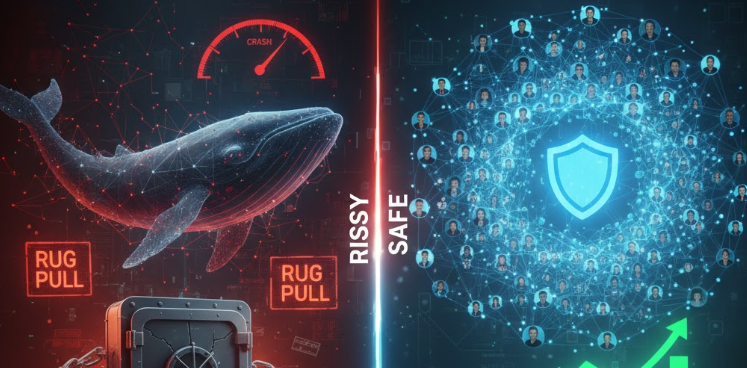
Red Flags to Watch When Assessing DeFi Safety

DeFi safety red flags matter more than ever. Decentralized finance promised open access, transparency, and financial freedom. It delivered innovation at breathtaking speed. However, it also introduced new risks that traditional finance never faced at this scale.
In DeFi, there is no customer support desk. There is no guaranteed refund. When things break, funds vanish instantly. That reality makes safety awareness essential, not optional.
Many losses do not come from complex hacks. They come from ignoring obvious warning signs. Projects often reveal their weaknesses long before anything goes wrong. The challenge is learning how to spot those signals early.
This article explores the most critical DeFi safety red flags to watch, explains why they matter, and shows how to assess risk before committing capital.
Why DeFi Safety Red Flags Matter
DeFi safety red flags matter because decentralized systems shift responsibility to users. You are your own risk manager. No intermediary stands between you and failure.
Ignoring red flags often leads to:
- Permanent loss of funds
- Exploited smart contracts
- Rug pulls and exit scams
- Protocol insolvency
Understanding risk does not eliminate danger, but it reduces blind exposure.
Anonymous or Unverifiable Teams
Anonymity is not always bad, but it increases risk.
One of the most common DeFi safety red flags is a fully anonymous team with no verifiable track record. While some successful projects began anonymously, many scams hide behind it.
Red flags include:
- No real names or backgrounds
- Fake profiles or stock photos
- No prior development history
- Refusal to engage publicly
Trust requires accountability. Lack of identity removes consequences.
Unclear or Copy-Pasted Whitepapers
Documentation reveals intent.
A vague or recycled whitepaper is a major DeFi safety red flag. Serious projects explain how they work, what risks exist, and how value is created.
Warning signs include:
- Buzzwords without explanation
- Copied sections from other projects
- No risk disclosures
- Unrealistic promises
Clarity signals competence. Confusion signals danger.
Unrealistic Yield Promises
If returns sound too good, they usually are.
Excessive yields are among the loudest DeFi safety red flags. While DeFi can generate high returns, sustainable yield always has a source.
Be cautious when:
- APYs are triple or quadruple digits
- Rewards rely solely on token inflation
- No explanation of revenue generation
- Returns depend on constant new users
Unsustainable yield collapses quickly when demand slows.
Lack of Smart Contract Audits
Code is law in DeFi.
One of the most serious DeFi safety red flags is unaudited or poorly audited smart contracts. Audits do not guarantee safety, but they reduce known vulnerabilities.
Audit-related warning signs include:
- No audit reports available
- Audits from unknown firms
- Outdated audits after major updates
- Ignoring known vulnerabilities
Security review is a baseline requirement, not a luxury.
Admin Keys and Centralized Control
Decentralization should reduce single points of failure.
Admin keys that allow developers to pause contracts, drain funds, or modify rules represent a major DeFi safety red flag.
Centralized control risks include:
- Emergency functions without transparency
- Ability to change fees or rules instantly
- Unclear governance processes
- No time-locks on changes
Power concentration undermines trust.
Poor Liquidity and Thin Markets
Liquidity equals exit options.
Low liquidity is a subtle but dangerous DeFi safety red flag. It limits your ability to exit positions without heavy losses.
Be cautious when:
- Liquidity pools are small
- One wallet dominates liquidity
- Slippage is extreme
- Liquidity is unlocked and removable
Illiquid markets trap capital when sentiment shifts.
Token Distribution Imbalances
Who owns the tokens matters.
A skewed token distribution is a major DeFi safety red flag. If insiders control most of the supply, they control price action.
Watch for:
- Large team allocations
- No vesting schedules
- Single wallets holding massive percentages
- Sudden large transfers
Concentration creates manipulation risk.
Rug Pull Indicators
Rugs rarely happen without warning.
Common DeFi safety red flags preceding rug pulls include:
- Liquidity that can be removed instantly
- Sudden changes to token contracts
- Aggressive marketing without substance
- Developers avoiding technical questions
Rug pulls are planned events, not accidents.
Complexity Without Purpose
Complexity increases attack surface.
Overly complex protocols often hide weaknesses. Complexity without clear benefit is a DeFi safety red flag.
Warning signs include:
- Unnecessary layers and mechanics
- Confusing reward structures
- No clear user benefit
- Lack of documentation
Simple systems are easier to secure and understand.
Inactive or Overhyped Development
Both extremes are dangerous.
No development activity signals abandonment. Constant hype without progress signals distraction.
DeFi safety red flags include:
- No GitHub updates
- Empty roadmaps
- Endless announcements without delivery
- Focus on marketing over building
Progress should be visible and measurable.
Governance That Exists Only on Paper
Governance must function in practice.
A governance token alone does not ensure decentralization. Broken governance is a hidden DeFi safety red flag.
Watch for:
- Low voter participation
- Proposals ignored by developers
- Unclear voting power rules
- Centralized overrides
Real governance requires participation and enforcement.
Protocol Dependencies and Hidden Risk
DeFi is interconnected.
Many protocols rely on others for liquidity, pricing, or execution. These dependencies introduce cascading risk.
Hidden DeFi safety red flags include:
- Heavy reliance on single oracles
- Exposure to fragile protocols
- Circular dependencies
- No contingency plans
One failure can trigger many.
Oracles and Price Manipulation Risk
Prices drive liquidations and payouts.
Weak oracle design is a major DeFi safety red flag. Manipulated prices cause instant losses.
Oracle risk appears when:
- Single data sources are used
- Low-liquidity markets feed prices
- No safeguards against flash loans
- Updates lag real markets
Reliable pricing protects protocol integrity.
Poor Communication During Incidents
Silence during crisis is dangerous.
How teams respond to problems reveals their competence. Poor communication is a strong DeFi safety red flag.
Warning behaviors include:
- Delayed incident disclosure
- Blaming users instead of addressing issues
- Vague explanations
- Deleting messages
Transparency matters most when things go wrong.
Inadequate Risk Disclosures
Every system has risk.
Projects that deny risk signal immaturity. Lack of honest risk disclosure is a DeFi safety red flag.
Responsible teams acknowledge:
- Smart contract risk
- Economic risk
- Governance risk
- Market risk
Honesty builds trust.
Forks Without Innovation
Forking is common. Blind copying is risky.
Many scams reuse existing code without understanding it. Forks without improvement raise DeFi safety red flags.
Concerns include:
- No explanation of changes
- Outdated code versions
- Missing security fixes
- No original contribution
Innovation suggests understanding. Copying alone does not.
Community Behavior as a Signal
Communities reflect leadership.
Toxic, censoring, or overly defensive communities often signal deeper issues.
Community-related DeFi safety red flags include:
- Banning reasonable questions
- Excessive price talk
- Cult-like behavior
- Harassment of critics
Healthy communities allow skepticism.
Legal and Regulatory Ignorance
Ignoring regulation does not remove risk.
Projects that dismiss legal considerations entirely may expose users to sudden shutdowns.
Regulatory red flags include:
- No jurisdictional clarity
- No compliance discussion
- Promises of “untouchable” status
- Encouraging evasion
Uncertainty increases downside risk.
Past Incidents and Unresolved Issues
History matters.
Projects that suffered exploits without fixing root causes raise DeFi safety red flags.
Be cautious when:
- Incidents are downplayed
- No post-mortems exist
- Similar vulnerabilities remain
- Lessons are not documented
Learning from failure builds resilience.
How to Evaluate DeFi Projects Safely
No single factor decides safety.
A holistic approach reduces risk. Combine technical, economic, and behavioral signals.
A safer evaluation includes:
- Reviewing audits and code
- Analyzing tokenomics
- Observing team behavior
- Assessing community quality
Patterns reveal truth.
Risk Management Is Personal Responsibility
DeFi removes intermediaries.
That freedom comes with responsibility. Ignoring DeFi safety red flags shifts risk onto you alone.
Smart users:
- Diversify exposure
- Limit position sizes
- Avoid emotional decisions
- Accept that loss is possible
Discipline protects capital.
Why Red Flags Are Often Ignored
Greed clouds judgment.
Fear of missing out overrides caution. Early gains feel validating. Red flags are rationalized away.
Recognizing this bias is part of safety. Emotional awareness prevents costly mistakes.
The Value of Patience in DeFi
Opportunities repeat.
There will always be another yield farm. Another protocol. Another trend.
Waiting for clarity often costs less than rushing into uncertainty.
Patience is an underrated defense.
Conclusion
DeFi safety red flags exist to protect those willing to see them. Most failures are not unpredictable. They follow patterns that repeat across projects and cycles.
By paying attention to team transparency, smart contract security, token distribution, governance, and communication, investors reduce exposure to avoidable risk. Decentralized finance rewards innovation, but it punishes carelessness.
In a system without safety nets, awareness becomes the most valuable asset. The best returns often belong to those who survive long enough to earn them.
FAQ
1. What are DeFi safety red flags?
They are warning signs indicating elevated risk in DeFi projects, including governance, security, and economic issues.
2. Are audits enough to guarantee safety?
No. Audits reduce risk but do not eliminate it. Ongoing vigilance is still required.
3. Is anonymity always a bad sign in DeFi?
Not always, but it increases risk when combined with poor transparency.
4. Why do high yields often signal danger?
Because unsustainable rewards usually rely on inflation or new entrants.
5. How can beginners reduce DeFi risk?
Start small, research thoroughly, diversify, and watch for common red flags.